
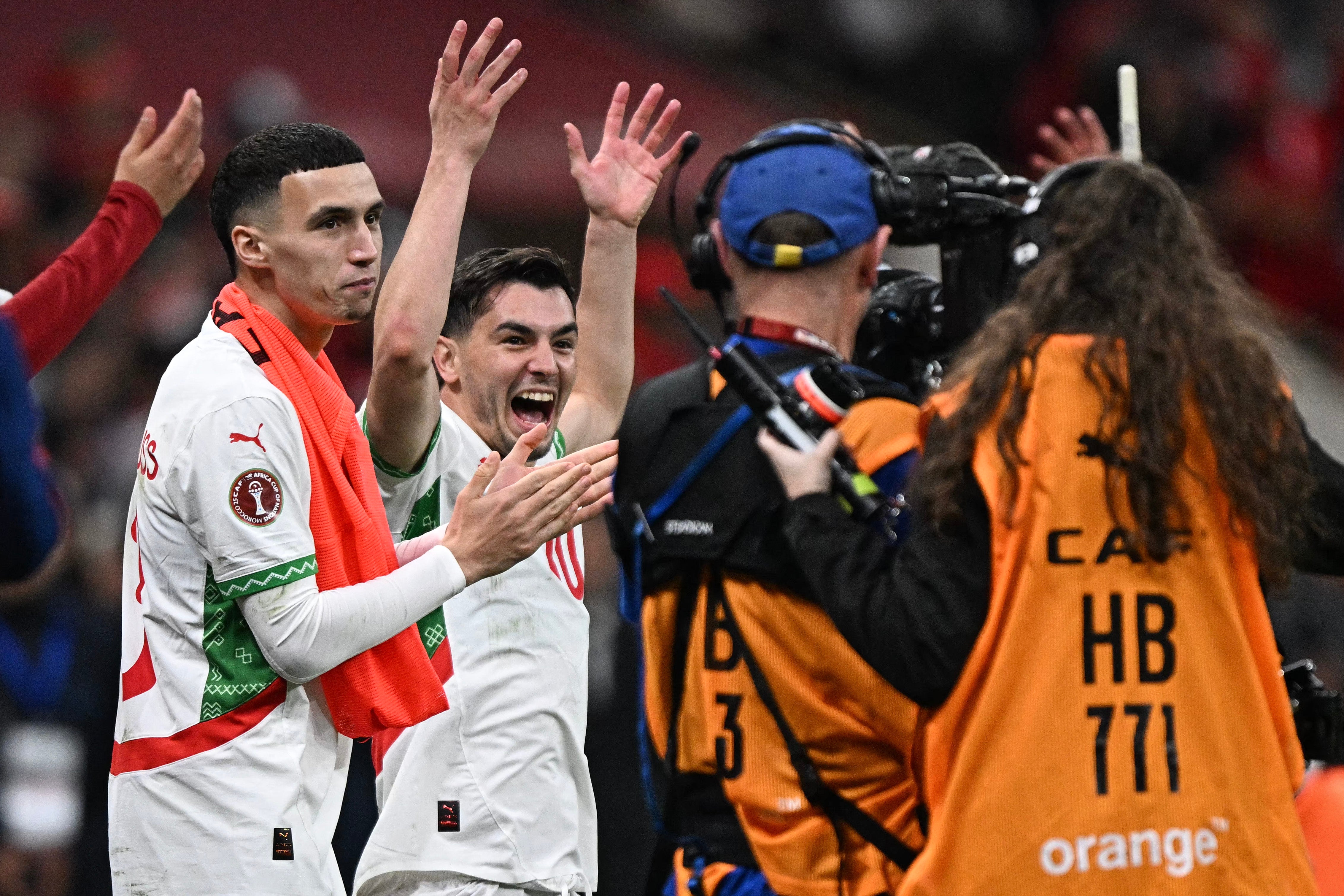
Diaz shines as Morocco end Cameroon’s AFCON dream and march into historic semi-final
Morocco are through to the semi-finals of the Africa Cup of Nations after a commanding 2–0 victory over Cameroon in Rabat, a result that has become one of the most discussed fixtures in African football today.[1][2][3]
Backed by a packed Prince Moulay Abdellah Stadium, the hosts delivered on expectations, combining attacking flair with defensive control to knock out five-time champions Cameroon and move to within one game of the final.[2][4]
The match’s opening stages set the tone: Morocco pressed high, pinned Cameroon in their own half, and immediately tested the Indomitable Lions’ back line. A Moroccan penalty appeal for handball inside the first minute was waved away, but it underlined the hosts’ aggressive intent.[3]
The breakthrough came in the 26th–27th minute from a set piece. A corner was flicked on by striker Ayoub El Kaabi, and Brahim Díaz reacted quickest, guiding the ball in from close range for his fifth goal in as many AFCON matches.[1][2][3][4] The Real Madrid winger has now scored in every round of the tournament so far, cementing his status as Morocco’s standout attacking threat.
Cameroon struggled to respond in the first half. Morocco’s midfield dictated the tempo, while defenders Nayef Aguerd and Achraf Hakimi helped keep Bryan Mbeumo and the Cameroonian forwards largely on the periphery.[3][4] When Cameroon did find a way through, captain Nouhou Tolo and centre-back Samuel Kotto produced crucial clearances at the other end to keep the scoreline respectable.[1]
The pattern shifted slightly after the interval as Cameroon, chasing the game, pushed higher and tried to exploit spaces out wide. Substitute Georges-Kévin Nkoudou came close with one of their few clear sights of goal, but Morocco’s defensive structure and pressing quickly reasserted control.[1][4]
Any hope of a late Cameroon comeback effectively ended in the 74th minute. Another dead-ball situation was only partially dealt with, and Ismael Saibari, left unmarked in the box, drilled a low shot inside the far post to make it 2–0 and ignite celebrations in the stands.[1][2][3][4] Saibari, who had faced criticism earlier in the tournament, delivered a decisive moment when it mattered most.
From there, Morocco managed the game professionally, maintaining defensive discipline and denying Cameroon sustained pressure.[4] The Indomitable Lions, who entered the tournament with ambitions of adding a sixth continental title, could not find the creativity or cutting edge needed to break down the hosts.
The result is significant on multiple levels. For Morocco, it marks a return to the AFCON semi-finals for the first time in more than two decades, ending a long wait since their last deep run at the tournament.[2][3] Coach Walid Regragui praised his players but urged caution, insisting that the team “hasn’t achieved anything yet” and must keep progressing one match at a time.[2]
Regragui also noted that the performance, while strong, was not flawless, pointing to periods in the second half when Cameroon were allowed to grow back into the game and highlighting areas for improvement before the last-four clash.[1] Nonetheless, he described the victory as “historic” for home supporters who have not seen Morocco this far in AFCON since the early 2000s.[2]
For Cameroon, coach David Pagou – who took charge shortly before the tournament – focused on the positives, saying he was pleased with how his players had brought joy to the Cameroonian public despite the quarter-final exit.[2] However, the defeat extends Cameroon’s recent frustrations at AFCON, with questions likely to be asked about their transition, squad depth, and long-term tactical direction.
Analytically, Morocco’s win reinforced several key trends from their campaign:
• Set-piece efficiency: Both goals originated from dead-ball situations, underlining rehearsed routines and sharp execution.[1][3][4]
• Star form of Brahim Díaz: With five goals in five matches, Díaz has emerged as one of the tournament’s most influential players, offering creativity and finishing from wide areas.[1][2][3][4]
• Defensive solidity: Conceding few clear chances even against a historically strong attacking nation like Cameroon reflects Morocco’s organisation and work rate without the ball.[1][3][4]
The victory sets up a high-stakes semi-final at the same Rabat venue, where Morocco will face the winner of the quarter-final between Nigeria and Algeria.[2][3] With Senegal also advancing on the other side of the draw, the hosts remain among the favourites but will be under intense pressure to convert home advantage into a first continental title since 1976.
Across social media and sports coverage in India and globally, “Cameroon vs Morocco” has trended as fans react to the Atlas Lions’ composed display, Díaz’s prolific scoring run, and the broader narrative of an African powerhouse reasserting itself on home soil. For neutral viewers, the result adds further intrigue to a tournament already rich with storylines and sets up a compelling final week of knockout football.
Tags:
Sources:
english.ahram.org.eg
www.france24.com
www.espn.in
www.dawan.africa
www.psg.fr